Consciousness in the Orchestra – on Berlioz's Symphonie Fantastique
Updated: Sep 4

Harriet Smithson as Ophelia. It was in this role that Berlioz saw her in Paris in 1827 — the actress who became the symphony's idée fixe. Public domain · Wikimedia Commons
I. The Hesitant Opening
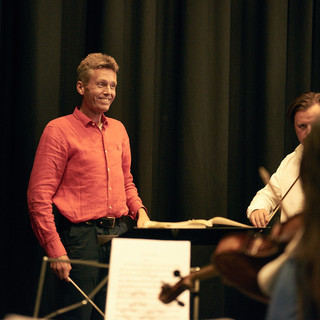
I remember one particular experience of this work more vividly than any other. I was a young violinist and sat at the first desk of the Nederlands Philharmonisch Orkest, playing Symphonie Fantastique in the Concertgebouw in Amsterdam under Hans Vonk. Vonk was a highly regarded conductor, but it was at this concert that his muscular disease began to show clearly. Towards the end he could barely stand without clinging to the music stand.
I have often thought about it since. A conductor whose body was failing him, leading an orchestra through precisely this work – a symphony about a consciousness losing its grip on itself, hallucinating, distorting its own inner image, and finally seeing its own decapitation. I do not know whether Vonk himself thought along those lines, but for me the memory has remained as a reminder of what Symphonie Fantastique really is: music about a consciousness, seen from within.
That is perhaps why I have kept coming back to this work. Not because it is easy to admire – Symphonie Fantastique is not a work one falls in love with straight away, in the way one can with a Mozart symphony or a Brahms adagio. But because it put a question to me that I did not know music could put: what is it to hear a consciousness, and not merely a narrative about one?
Symphonie Fantastique opens differently from any symphony before it. Muted strings, slow, searching, subdued. This is not what we associate with 1830, and certainly not what Beethoven had established about how a symphony should open. I think of Symphonie Fantastique as a piece of music that knows from its first bar that it wants something different.
I have studied this score closely over years, and that gives me a particular relationship to the work: I know it as architecture, from inside the notes, and I therefore believe I read it with a specific kind of listening – one that thinks each orchestral element on its own terms, not as the combined mass of sound heard from the audience.
The first thing that strikes me in that listening is how radically Berlioz opens. He does not let you into a symphonic landscape with familiar proportions – a solemn fanfare, a clear modulation, a main theme. He lets you into a head. A head searching for something, that has not yet found form, that remembers, that dreams. It is an opening that asks the listener to move from the room outside to the room inside, and I believe Berlioz knew he was demanding precisely this shift of his 1830 audience.
This shift is what Symphonie Fantastique is. It is what I believe the work is about, and it is what the work requires.
II. A Work Without Precedent
To understand how radically Berlioz broke with Symphonie Fantastique, I believe it is necessary to remember what he was breaking with.
Beethoven had died on 26 March 1827. When the symphony had its premiere at the Paris Conservatoire on 5 December 1830, it had been less than four years since the man who had defined what a symphony was had stopped composing. The Ninth Symphony must still have been an open wound in Europe's musical consciousness. Nobody knew what the symphonic form could be after Beethoven. Should one continue in his footsteps, or break away?
Berlioz was 26 years old. He had just finished his studies at the Conservatoire and was still outside the established circles of musical life. And he wrote a symphony that broke with Beethoven on nearly every point.
Paris in 1830 was a city in intellectual ferment. The July Revolution had just overthrown Charles X, the Romantic generation was in the process of defining itself in literature and painting – Victor Hugo, Delacroix, the young critics around the new journals – and musical life found itself in a transitional period between what Beethoven had left behind and what no one yet knew would come. Berlioz had that same year finally won the Prix de Rome after several attempts – a prize he had a complicated relationship with, and which would send him to Rome the following year, reluctantly, with the Symphonie Fantastique score just completed. He was, in other words, young and radical at a moment when it was possible to be so – and ambivalent towards the institutions that were trying to confirm him.
The symphony had five movements, not four. It had an explicit programme – Berlioz handed out the programme to the audience, a story about an artist who takes opium and hallucinates about his beloved. It used an idée fixe, a theme that transforms across the movements, more the way an opera aria had used character themes than the way the symphony had treated its thematic material. It called for an orchestration no one before had dared: two harps, cor anglais, an oboe placed offstage, church bells, col legno in the strings, and in the finale an open quotation of the Dies Irae from the Gregorian requiem mass.
And beneath all this: a theme that was Berlioz's own obsession. He had seen the Irish actress Harriet Smithson in Paris in 1827, in Shakespeare's Ophelia and Juliet – in a language he barely understood, but in performances that shook him completely. He fell in love with her without having exchanged a word with her. Infatuation became obsession, obsession became an idée fixe, and the idée fixe became the symphony. The idée fixe theme is Harriet Smithson – or, more precisely, what Berlioz's own consciousness had made of her.
The premiere was a success with a small but decisive audience. Liszt was present – he was overwhelmed, and would later transcribe the entire symphony for piano. The work was obviously something new; the question was what.
What I believe we can now see in retrospect is that Symphonie Fantastique set a precedent for everything that came after it. Liszt's symphonic poems take their inheritance directly from Berlioz's programme-idea. Wagner's leitmotifs have a clear forerunner in the idée fixe method. Mahler's explicitly programmatic symphonies – particularly the Second and Third – develop the idea of the symphony as the unfolding of an inner world. Strauss's tone poems carry orchestration-as-narrative to its ultimate consequence. Berlioz himself, thirteen years later, would write the great Traité d'instrumentation, which became the textbook for the whole of nineteenth- and twentieth-century orchestration – Symphonie Fantastique is the work in which the principles were discovered, the book is where they were systematised. And film music's fundamental discovery – that sound can be a character's consciousness, not just an atmosphere – I believe lives on in the legacy of Symphonie Fantastique every time we hear it used.
III. Consciousness as Sound
My reading of the work – and it is a reading, not a truth – is that Symphonie Fantastique is the first work in which the orchestra is so openly moved into a consciousness.
It is not that the music is programmatic. Programmatic music had existed long before Berlioz – Vivaldi's Seasons, Beethoven's Sixth, Mendelssohn's Hebrides. This is something else. In earlier programmatic music the sound points outward, towards an external phenomenon it resembles: a storm, a bird, a brook. The sound is an illustration.
With Berlioz I experience the sound as pointing inward. The cor anglais playing alone towards the end of Scène aux champs, without receiving an answer from the oboe it had called out to, is not an illustration of "a lonely shepherd". It is the very sound of loneliness. The drums that announce the fall of the head in Marche au supplice are not a picture of "a march" or "a heartbeat" – they are a kind of heart and a kind of dread fused together, heard from within. The rhythmic repetitions of the witches' sabbath in the finale are not an illustration of "wild dance" – they are a consciousness that no longer has control over what is rhythm and what is repetition.
What Berlioz invented, I believe, was a way of orchestrating in which the sound does not point towards anything outside itself. It is consciousness. That is one of the most important revolutions in what music can do, and in my view it is the core of why Symphonie Fantastique still moves us two centuries later.
This has a consequence for me as a conductor. If the work were an illustration of a programme – the artist goes to a ball, the artist sees a landscape, the artist is beheaded – then my task would be to deliver a story. Simply to tell it as clearly as possible.
But if the work is a consciousness, the conductor's task must be something else. I believe the task is to turn the orchestra into a head: every inner voice must live as a thought, every transition between movements must function as an associative trail, and above all the orchestra must never sound like an orchestra delivering a piece. It must sound like someone remembering.
Berlioz himself was ambivalent about the status of the programme. Sometimes he insisted that the programme be distributed to the audience; other times he said the music could stand alone. I believe this ambivalence is honest: the programme is a help, but it is not the matter. The matter is that we find ourselves inside a consciousness for nearly an hour, and whose consciousness is not the most important thing – that we are there, is.
IV. Three Moments That Open
Three moments in the score make this clear to me.
The first is the idée fixe theme and its transformations. Berlioz introduces it in the Allegro section of the first movement, after the slow introduction. It is a long, singable melody in the violins – not a symphonic theme in the Beethoven tradition, but almost an aria, a melody that will be remembered because it must be remembered. The idée fixe is Harriet Smithson; it is the obsession.
What is radical is what happens to the theme over the next four movements. In Un bal (second movement) it appears as a waltz-like figure, still recognisable, but now coloured by the tonality of the ball. In Scène aux champs (third movement) it returns, but more distant, as if consciousness has for a moment succeeded in placing it at arm's length. In Marche au supplice (fourth movement) it is cut off just before its climax – a brief echo of the theme, only to be interrupted by the falling stroke of the guillotine. And in the finale, Songe d'une nuit du sabbat, we recognise the theme at last, but now grotesquely distorted: played by the E-flat clarinet in a parodic, contorted version. The beloved's most sacred image has become a demon.
That, I believe, is what the idée fixe concept does: it shows us the history of a consciousness. The same theme, the same melody, undergoes all the transformations an obsession undergoes – from pure ideal, to the fleeting figure of a dream, to the memory held at a distance, to the brief flash of its being pierced through, to the final distortion. It is consciousness in time.
The second is the pastoral's unanswered dialogue. The third movement, Scène aux champs, opens with a cor anglais onstage playing a melody in free tempo, a kind of shepherd's call. An oboe placed offstage answers. They hold a light, extended dialogue – two shepherds calling to each other across the meadow, and this is what Berlioz's programme explicitly says they are.
But towards the end of the movement, after the main material has been worked through and a distant thunder has been heard in the timpani, the cor anglais returns with its call. Quiet. Questioning. The horn waits for an answer.
No answer comes. The oboe offstage is gone. The cor anglais stands alone with its question, and what Berlioz has written in is timpani – not as answer, but as distant thunder, as a kind of non-answer. I experience the movement as ending in a question mark.
This moment is what I mean by sound as consciousness. The unanswered call is not an illustration of "loneliness". It isloneliness. It is the sound of a voice searching for another and not receiving one. I believe the conductor who lets it remain as an open question has found what Berlioz actually wrote.
The third is the col legno passage in the finale. The work has up to this point stayed within a recognisable symphonic grammar – expanded, but recognisable. In the finale the grammar breaks. Berlioz opens Songe d'une nuit du sabbatwith grinding strings and gesticulating woodwinds, church bells enter with heavy, sacral strokes, and low winds intone the Dies Irae in a harmonic garb that renders the requiem mass's day-of-judgement melody blasphemous. Consciousness has slipped into a place where even the sacred has become distorted. It is there, in the middle of this breakdown, that the col legno passage stands.
The strings are instructed to turn the bow and use the wood of the bow's edge instead of the hair. It produces a dry, bone-like sound – as if the instruments have suddenly become implements, not voices. In 1830 this was an orchestral novelty without parallel, and it is still one of the symphony's most haunting sounds.
The gesture is not effect. It is a precise consequence of the consciousness-thesis: here the inner voice has lost faith in its own instrument. The strings, which through the movements have carried the idée fixe, which have sung the artist's love and his pain, are now reduced to pieces of wood against string. Consciousness no longer hears its own song. It hears its own skeleton. That is what col legno does at this place, and that is why it stands there.
V. Coda
After nearly an hour, the consciousness is finished. The symphony stops, the listener returns to the concert hall, and it takes a while to come back.
Symphonie Fantastique is not an easy story. It asks the listener to remain inside the consciousness of an obsessed man, through dream and dread and distortion, all the way into the grotesque. It promises no reconciliation, and does not try to console. What the work gives us is something else: to know that music can be inside a head, not merely outside it. It is a possibility we have taken for granted since Berlioz, and one for which we can thank him.
The work is nearly two hundred years old, but it bears new listenings, generation after generation. Berlioz is dead, Harriet Smithson is dead, the young artist is a fiction. What holds the work together is not the story. It is the way of hearing that Berlioz invented: that sound itself can be an inner life. Each time we listen, the consciousness comes into being anew.
That is what Berlioz discovered on 5 December 1830, and it is what Symphonie Fantastique still shows us: that sound can be soul.


Comments