The Difficult Simplicity of La Traviata. On aristocratic Verdi.
- Vegard Nilsen
- Aug 5
- 9 min read
Updated: Aug 6
I. The First Rehearsal
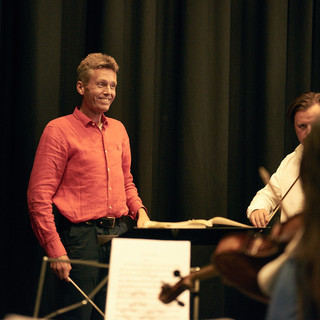
I thought I knew La Traviata. It took me half an hour of the first rehearsal to understand that I really didn't. And this was only the overture, which I had conducted on a couple of very successful occasions before. Or at least, so I had thought.
I was new as a conductor, and had an unfamiliar orchestra in front of me. Several of the arias felt as though they were already in my head and hands from other projects; that had worked. What I had not reckoned with was that it did not work – that I could not bring the orchestra with me even in the prelude.
On paper, the prelude to La Traviata is almost nothing. A wafer-thin string melody over a tonal skeleton. Pianissimo, divisi, high up. No harmonic riddle, no extravagant orchestration, no figures to hide behind. These are the bars Verdi has placed at the very front of one of music history's most performed operas – and they are the hardest test the conductor and the orchestra will take together that afternoon. The litmus test lies in bar one.
I understood there, at that first rehearsal, that I had underestimated the opera. A work that looks so simple you think you can go straight to the melodies. And I think it is this – perhaps false – simplicity that makes La Traviata difficult, and at the same time makes the opera a masterpiece.
II. A Contemporary Drama on the Operatic Stage
To understand what I believe La Traviata actually is, I think it helps to remember what it was meant to break with.
When Verdi composed the opera in the winter of 1853, he had just finished Il Trovatore – a full-blooded Romantic drama with gypsies, witches, burning pyres and revenge on long lines. That was everything opera was allowed to be. La Traviata was to be something else. Verdi had seen Alexandre Dumas fils' play La Dame aux camélias in Paris the year before, and had been immediately gripped. The play was based on Dumas' 1848 novel, which was itself based on his own love story with the courtesan Marie Duplessis. Duplessis died of tuberculosis in 1847, at the age of 23. It was, in other words, a true contemporary drama that Verdi took on, not a reworking of ancient myth or medieval conflict.
That in itself must without doubt have been a provocation. Opera in 1853 was still, by and large, a costume drama. Women in the leading roles were to be queens, princesses, priestesses, mythological figures – or in distress, but rarely in contemporary distress. A courtesan on the operatic stage, in a dress from present-day Paris, dying of a disease that was actually killing young women at the time – it was something other than what the audience was used to. I imagine it was as if someone today were to write an opera about a woman from a modern city, with a modern disease, and insist that it was serious art. Today it would probably be accepted as serious art, but in 1853, norms of tolerance were evidently rather different from ours.
The premiere at La Fenice in Venice, on 6 March 1853, became one of music history's most notorious fiascos. The soprano Fanny Salvini-Donatelli was not only of mature age, but also, as contemporary reports tell us, not exactly slim. When she sang her death scene, the audience laughed openly. The tenor was hoarse. The baritone disliked his role. Verdi wrote shortly afterwards: "La Traviata was a fiasco. My fault or the singers'? Time will judge."
It did not take long. Just over a year later, in May 1854, the opera was staged again in Venice – now at the Teatro San Benedetto, with adjusted casting and some editorial changes to the score. It became a triumph. Still, I think it is worth noting that in many early productions the action was moved back to the eighteenth century, in powdered wigs and rococo costume, to make it "more operatic". This must, in my view, have been a concession: the contemporary drama was still hard to digest.
What Verdi did with the music, I believe, is the answer to this problem. He gave a courtesan from modern Paris the most dignified music he could write. He cooled things down where the audience perhaps expected melodrama. He built the arias with classical architecture, not with theatrical effect. Verdi was, as Muti has pointed out, strongly shaped by predecessors such as Haydn, Mozart and Schubert. He gave Violetta dignity – not by making her aristocratic by birth, but by letting the music rise to the seriousness she deserved. This is what Riccardo Muti calls aristocratic Verdi: a musical surplus, as though Verdi knew that the subject could sink unless it were held up by a compositional discipline greater than the subject itself.
III. The Reading
Stable tempi, absence of overstated affect, no exaggeration in any direction. Verdi as classicist, not as melodramatist. That, I believe, is among the hardest things in Verdi. It is tempting for a conductor, and for singers, to turn the aria into an effect, to stretch out the tempo where the audience expects to be moved, to rest on the familiar melody instead of letting it carry itself.
This is difficult because it often does not happen consciously. No conductor disturbs the text on purpose. I have experienced it myself as a gradual drift: beginning to build around the melody without noticing – adding a little here, stretching a little there, helping a passage where the audience expects to be moved. Each of these acts seems justifiable in the moment. Only when I step back do I see what I have done: built a wholly different opera from the one Verdi wrote. An opera with a greater outer effect. But also an opera in which the aristocratic surplus is gone, in which the music has lost the calm that lets it carry what it is meant to carry.
Aristocratic is not cool, mechanical, or ceremonious. On the contrary: it is the singable that truly emerges when a line is carried without playing itself. La Traviata is full of melodies that have almost become popular hits – "Brindisi", "Sempre libera", "Di Provenza il mar", "Addio del passato". I think the conductor who believes he is going to deliver melodies loses the work. The one who manages to hold the lines straight, without reinforcing what Verdi has already written in, gives the melodies back the possibility they were written for: to touch, to move.
This is not a reading I have invented on my own. It lies within a tradition that reaches back to Toscanini, who cleansed Verdi of the late-Romantic wrapping that had settled over the closing decades of the nineteenth century, and who insisted that what stands in the score is enough. Muti has carried the line forward in his generation, with the intellectual rigour he is known for, and it is his formulation, aristocratic Verdi, that I borrow when I try to describe what La Traviata demands. To take the opera in hand today is to stand within this line whether one knows it or not – every conductor makes a choice between layering affect upon affect, or letting what Verdi has already written into the score come into view.
When I say this, I do not mean to diminish the melodic – on the contrary. It is that the melody in Verdi is always anchored in something beneath it: a steady harmonic rhythm, a disciplined underlying pulse, an orchestration that does not try to hide that the structure is simple. It is this anchoring, I believe, that allows the voice to sing. Without the underlying pulse, the soprano has nothing to rest against. Without the harmonic discipline, she cannot choose her nuances against anything stable. Aristocratic bearing in the orchestra is, as I experience it, what gives the singer complete freedom – because she no longer has to build the stability herself.
IV. Three Details That Open
Three moments in the opera make this clear to me.
The first is the prelude to Act I. The work opens in E minor, with first and second violins divisi a quattro, high up, pianissimo. It is only the strings; no bass, no winds yet. The falling motif is simple in an almost provocative way – a chain of resolving chromatic tensions that opens and settles in slow rhythm. It is already a picture of Violetta. We hear her before we see her, and we hear her death before we have met her. After the opening bars, the prelude turns towards the major, and a flowing, more open line rises – it is the melody she herself will sing later, in the hardest hour of her life, when she gives Alfredo up ("Amami, Alfredo, quant'io t'amo"). The prelude thus gives us the whole of Violetta in miniature: her end and her capacity for love, side by side, before the opera has even begun.
If Verdi opens one of his most performed operas in this way, it seems to me that he must have known something about the material that we who play it often do not. To do this prelude right requires an orchestra that has learned to hold the line together at a low dynamic level, without breathing out of sync, without reinforcing. It requires, in short, an aristocratic bearing – in the place where it is most difficult, because it is most exposed.
The second is "Di Provenza il mar" – Giorgio Germont's aria to his son, after Alfredo has read Violetta's letter of farewell and understood that she has left him. Of all places in La Traviata, this is the aria I myself love the most. Many call him Papa Germont, and the name is no accident. He is often read as the opera's antagonist, the patriarchal pressure that has crushed Violetta's happiness. That is probably not wrong, but I don't think it is enough either. In "Di Provenza il mar" Verdi opens an unexpected warmth in Germont.
The aria is one of Verdi's simplest in form – ternary, with an orchestration so light that the melody almost stands alone. The tempo is Andante piuttosto mosso – not slow enough for us to slacken, not fast enough for us to hurry. The melody itself is close to a folk song in character, perhaps close to a lullaby in its fall. But beneath this simple line lies a harmonic foundation that moves slowly and heavily, and it is this anchoring that gives the aria its weight. It is not the melody that moves us alone. It is the simple melody embraced by a grave harmony.
Germont is not a cynical figure; he is a father, and I believe he carries fatherhood with a seriousness that cannot be reduced to his earlier demands. I think that the conductor who keeps the tempo stable, lets the breath be long, and lets Verdi's simple melody be carried without being wrapped in affect – that conductor finds what Germont is really saying to his son: that there is a homecoming. Not because he understands, but because he loves.
The third is the sequence that leads from the recitative "Attendo, attendo" into the aria "Addio del passato" in Act III. Preceding it is one of the opera's most unusual moments – the letter scene "Teneste la promessa". Violetta reads Germont's letter aloud, while the orchestra plays the "Di quell'amor" theme we heard in Act I, now slow and mournful. This is melodrama in its technical, original sense: speech over music, a form Verdi rarely used. The letter says that Alfredo is coming, but she understands that it is too late. She has read her own death in his handwriting.
Then: "Attendo, attendo, né a me giungon mai!" I wait, I wait, but they never come to me. It is there, in the recitative before the aria, that I feel the loneliness is at its most naked. For me it is not the farewell that is Violetta's loneliness – the farewell is her conscious act, her dignity under the anticipation of death. The loneliness is in the seconds before she decides to say goodbye.
The aria that follows, "Addio del passato", is two verses for soprano with reduced orchestra. The characteristic oboe follows and mirrors the soprano's line throughout the aria, giving the music its fragile, wistful colour. It is one of the opera's simplest arias, and one of the hardest to carry. It requires that the singer not try to make it larger than it is. It requires that the conductor keep the pulse so steady that the soprano can sing with all the fragility the work grants her.
V. Coda
When the prelude to Act III begins, we hear the falling motif again. The same notes, the same voices. But it is not the same music. What we have lived through since Act I – Violetta's choice, Germont's imposition, Alfredo's misunderstanding, Flora's party, the collapse – has given the motif a different weight. It is as though everyone, not just Violetta, has gathered life experience between the two preludes. The first prelude said: this will end this way. The second says: now we know why.
That is where La Traviata shows what it actually is. Not first and foremost an opera about love and death, not a tragedy about a woman who loses her chance at happiness. It is an opera in which loneliness and warmth live side by side. One does not outweigh the other. Both are true at the same time.
That is Verdi as classicist. And that is what the false simplicity opens.
Comments